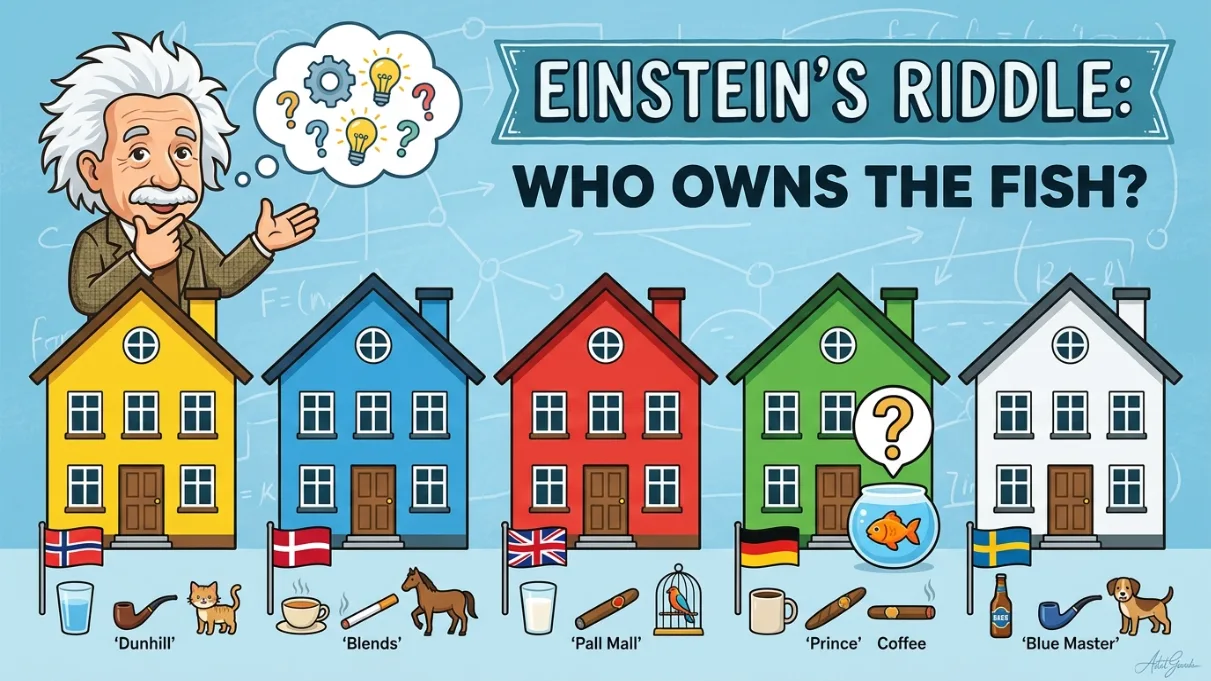
Einstein’s Riddle: Who Owns the Fish?

Einstein's Riddle, sometimes called the Zebra Puzzle or the 5-house problem, is one of the most well-known logic puzzles ever put to paper. The popular claim is that Einstein wrote it as a boy and estimated that only 2% of people could crack it. The authorship has never been confirmed, but the difficulty is real.
The setup is straightforward: five houses stand in a row, each painted a different color, each owned by a person of a different nationality. Each person drinks a specific beverage, smokes a specific brand of cigarettes, and keeps a specific pet. Nothing overlaps. Your task is to work through 15 clues and figure out who owns the fish 🐟.
No guessing is needed. Every answer follows logically from the clues. When you get it right, you know it.
🧩 Interactive Puzzle Solver
🧠 EINSTEIN'S RIDDLE📋 The 15 Clues
✏️ Fill in the Grid
| Category | 🏠 House 1 | 🏠 House 2 | 🏠 House 3 | 🏠 House 4 | 🏠 House 5 |
|---|
🧠 How to Solve Einstein's Riddle
This puzzle belongs to a category mathematicians call a constraint satisfaction problem. There is exactly one valid solution, and it can be reached through deductive reasoning alone. The 15 clues form a closed system; each one narrows the possibilities until only one arrangement fits.
📍 Begin with fixed positions
Two clues give you absolute starting points. Clue 9 states the Norwegian lives in house 1. Clue 8 states the person in house 3 drinks milk. Write both down immediately. These are the anchors from which everything else follows. Clue 14 then confirms that since the Norwegian occupies house 1, the neighboring blue house must be house 2.
❌ Work through elimination
Once an attribute is placed in a house, it cannot appear in any other. After confirming the Norwegian is in house 1, you can remove "Norwegian" from consideration for all remaining houses. Repeat this process across every category and the grid fills faster than it initially seems.
↔️ Handle adjacency clues with care
Several clues use the phrase "lives next to," which means immediately to the left or right. These clues limit where certain attributes can go without fixing them outright. Test each possible position against your existing entries. A contradiction with any confirmed clue means that position is ruled out.
🔗 Connect attributes across categories
The puzzle has five categories: color, nationality, drink, cigarette brand, and pet. Each category has five options. When clue 13 tells you the German smokes Prince and you have already identified which house the German lives in, that cigarette placement is settled too. These cross-category links are where most of the puzzle gets resolved.
🐟 The final answer
As the grid fills in, the remaining options collapse quickly. By the time 24 of the 25 attributes are placed, the last one is determined automatically. The German in house 4 is the fish owner.
👁️ SHOW FULL SOLUTION
⚠️ Spoiler below. Try the puzzle first before reading on.
| Category | House 1 | House 2 | House 3 | House 4 | House 5 |
|---|---|---|---|---|---|
| 🎨 Color | Yellow | Blue | Red | Green | White |
| 🌍 Nationality | Norwegian | Dane | Brit | German | Swede |
| ☕ Drink | Water | Tea | Milk | Coffee | Beer |
| 🚬 Cigarette | Dunhill | Blends | Pall Mall | Prince | BlueMaster |
| 🐾 Pet | Cats | Horses | Birds | 🐟 Fish ← | Dogs |
🇩🇪 The German owns the fish.
📜 The History of Einstein's Riddle
Despite its name, no credible evidence connects this puzzle to Albert Einstein. The attribution appears to be a marketing invention — the kind of shorthand that sticks because the name adds weight. The puzzle was first published in Life International magazine in December 1962, credited only to "the puzzle editor." A version appeared in Life the following year, and that is where most of the early documentation ends.
The alternate name, the Zebra Puzzle, comes from a version where the final question asks who owns the zebra rather than the fish. The underlying structure is identical. Both versions circulate widely, and several minor variations exist with different nationalities or brands substituted in. The logic, however, never changes.
What makes the puzzle hold up across sixty years is its construction. The 15 clues are precise enough to produce exactly one solution, but loose enough that the path to that solution is not obvious. It is a well-designed constraint system, which is probably why computer scientists use it as a benchmark problem for logic solvers and AI reasoning engines.
🧪 What This Puzzle Actually Tests
Solving Einstein's Riddle requires holding a lot of information in working memory at once. You track five categories across five positions, updating your picture of the grid every time a new deduction is made. That cognitive load is part of what makes the puzzle genuinely hard for most people on a first attempt.
The skills being exercised here are deductive reasoning, systematic elimination, and the ability to spot when a partial conclusion creates a contradiction somewhere else in the grid. These are not exotic abilities, but they do require focused attention and a willingness to backtrack when an assumption proves wrong.
Regular practice with logic puzzles of this kind has been linked in several cognitive studies to improvements in working memory and reasoning speed. The effect is modest and not a substitute for sleep or exercise, but the connection is consistent enough to be worth noting. Fifteen minutes with a grid puzzle is at minimum a better use of attention than most alternatives.
❓ Common Questions
Did Einstein actually create this riddle?
Almost certainly not. No documented evidence links the puzzle to Albert Einstein. It first appeared in Life International magazine in 1962, credited to the publication's puzzle editor. The Einstein name was likely attached afterward, possibly to make the puzzle sound more prestigious or to explain its difficulty.
Is there only one correct solution?
Yes. The 15 clues together constrain the problem so that only one arrangement of all 25 attributes satisfies every condition at once. The answer is always the same: the German in house 4 owns the fish.
How long does it take to solve?
It depends heavily on experience with logic puzzles. Someone who has worked through similar grid problems before might finish in 20 to 30 minutes. A first attempt often runs 45 minutes to two hours. Working on paper alongside this tool tends to be faster than relying on memory alone.
What is the Zebra Puzzle?
The Zebra Puzzle is another version of the same riddle. The question asked at the end is "who owns the zebra?" rather than who owns the fish. The clues, the number of houses, and the logical structure are the same. Both versions trace back to the same 1960s magazine publication.
Can children solve Einstein's Riddle?
Most children under 12 will find it too demanding. Kids aged 13 and up who enjoy logic or math puzzles can work through it with patience. A good starting point for younger solvers is a 3-house or 4-house version of the same puzzle format, which covers the same reasoning skills at a lower volume of information.